|
|
|
Solar
Eclipses
for Those Who Want to Know and to See a Little Bit More |
|
Igor Stojanovic, Petar Glisovic and prof Stevo Segan
|
On August 17th and 18th 2006, at the International
Astronomical Union XXVI General Assembly in Prague, Commission 46 on Education and Development sponsored Special Session 2 (SpS2), entitled Innovation in Methods of
Teaching and Learning Astronomy. About 400 participants registered. Our
participation consisted of two poster presentations and
a short talk:
1. "Challenges
of Astronomy: classification of Eclipses",
2.
"History of Teaching Astronomy in Serbian Schools".
|
|
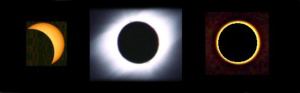
Solar eclipses can be partial, total
or annular. |
|
If you seen one, you probably
have seen some event like showed by the next unforgettable pictures.
|
|
 |
|
The latter two types also begin and end with a partial phases. In this
article have illustrated each type of eclipse using very interesting
approach. After calculating geocentric ecliptic and equatorial coordinates
of the Sun and of the Moon, we have choose the moving coordinate system with
origin in center of the Earth and with main axis towards the Sun's and
Moon's centers. The Sun is source of light and define the intersection
of the umbra and penumbral cone of the Moon's shadow with Earth's surface.
All numerical and visual effects are programmed in C++ and linking
with different possibilities of the DirectX.
|
|
[ source code ] |
|
|
|
Total Solar
Eclipse of 2006 March 29 |
| |
|
 |
|
[ video Djala(SCG) -11.08.1999. ] |
|
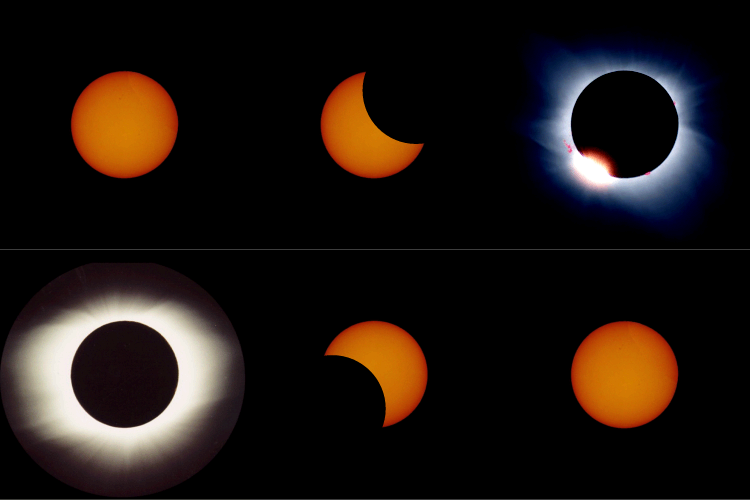
The animation illustrates a view of a total solar eclipse where partial
phases lead to one of nature's greatest spectacles, the Sun in total
eclipse with its glorious coronal halo.
|
| |
|
 |
|
[ animation 1 ] |
|
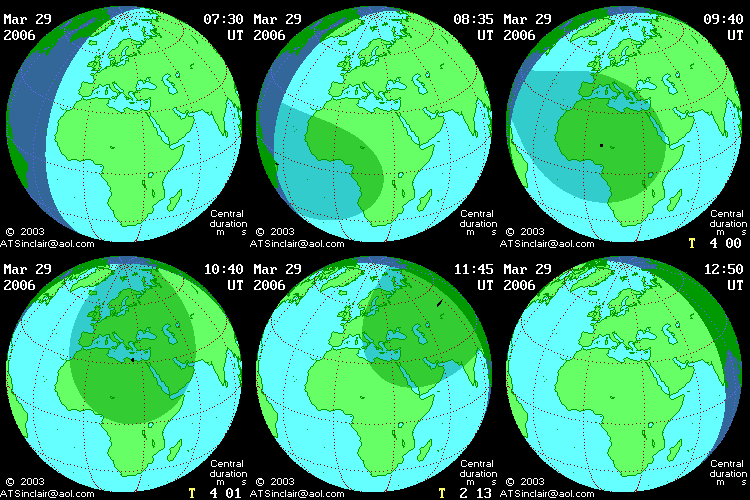
This animation
shows the path of the
Moon's umbral and penumbral shadows during the total solar eclipse of
2006 March 29. The moving dark blue area shows the nighttime areas of the
Earth.
The penumbra appears as a large grayish region that sweeps across the
Earth from west to east. Everyone within the penumbra's path sees a
partial eclipse of the Sun. Outside the penumbral path, no eclipse
is visible.
The Moon's dark umbral
shadow
appear as a tiny black dot at the center of the penumbra.
Only those within the narrow umbral path see a total eclipse.
|
| |
|
|
|
[
NEW !!! SOLAR ECLIPSES - 29.03.2006
] -
animation 2 |
|
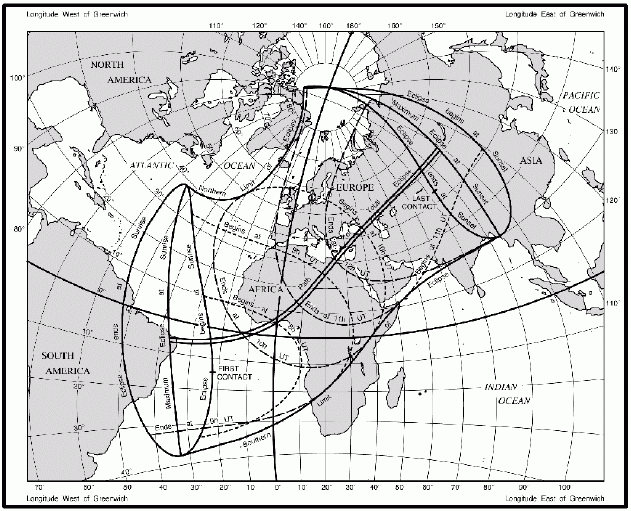
Short dashes
show the leading edge
and long dashes show the trailing edge.
Except for certain extreme cases, the shadow outline moves generally from
west to east. The Moon’s shadow cone first contact the Earth’s surface where
”First Contact” is indicated on
the diagram. ”Last Contact” is
where the Moon’s shadow cone last contacts the Earth’s surface. The path of
central eclipse, whether of
total, annular or annular-total eclipse, is marked by two closely spaced
curves that at across all of the dashed curves. These two curves mark
the extent of the Moon’s umbra shadow on the Earth’s surface.
Solid curves labeled ”Northern”
and ”Southern Limit of Eclipse”
represent the furthest extent north or south of the Moon’s penumbra on the
Earth’s surface.
Another set of
solid curves appears on some diagrams as two teardrop shapes (or
lobes) on either end of the eclipse path, and on other diagrams as distorted
figure eight. These lobs represent in time the
intersection of the Moon’s penumbra with the Earth’s terminator
as the eclipse progress. In the east, the outer portion of the lobe
is labeled ”Eclipse begins at Sunset”
and marks the first contact between the Moon’s penumbra and Earth’s
terminator in the east. The inner part of the lobe is labeled
”Eclipse ends at Sunset” and
marks last contact between the Moon’s penumbra and Earth’s terminator at
the east. A similar description holds for western lobe except everything
occurs at sunrise instead of sunset.
|
|
|
|
 |
|
|
Igor Stojanovic email:
lunachek@bitsyu.net
Petar Glisovic email:
psgras@drenik.net
prof Stevo Segan email:
ssegan@matf.bg.ac.yu |